

Why Quitting is Underrated
It is powerful to know when to walk away 🚶

Dear community 🧠
This week I have been thinking about quitting as a tool. 🔧
We live in a society that celebrates perseverance and grit. We’ve grown to believe that it is not okay to quit and that sticking to something is the key to success. All you need to do is to have the patience to wait for the good thing to happen after your hard work. We’ve grown up in a culture where quitting is synonymous with giving up and failure resulting in us feeling guilty for thinking of and actually quitting.
BUT quitting at the right time is a powerful skill that we all need to develop. ✔️
Have you ever got yourself saying “If I knew then what I know now, I would have done this differently”? Myself, many times 🙋
It is quitting that lets you have this thought after you acquired new information. It gives you the ability to react to changed things, which includes changes in your state of knowledge, the world or yourself. A lack of information always works against us when we make a decision.
Quitting Around Us
Famous mantras like “move fast and break things” are adopted by Silicon Valley for years now and are implemented through strategies like MVP (minimum viable product). MVP is an approach to work with an emphasis on speed and experimentation. The whole point of MVP is to get enough information (feedback from product users) to make the final product better, and know the strengths and weaknesses of a product. These strategies work only if you have the option to quit.
Quitting allows companies to maximize experimentation, speed and effectiveness in high-uncertainty environments. By moving fast, there is greater uncertainty due to the fact that there is less time in gathering the information required before acting. It is therefore important to gather the information quickly to know when to quit things that don’t work and develop things that might work better.

A good example of that is the development of Instagram. 📷
To begin with, the founders (Kevin Systrom & Mike Krieger) developed an app named “Burbn”. It was a check-in app with a photo-sharing feature. After getting $500,000 in investments for Burbn Systrom & Krieger realized that the market response to Burbn was not the desired. Burbn had about 100 users, so the founders asked the users what they liked about the app, and the answer was the "photo-sharing” aspect. So they decided to change the app, to make it photo-sharing and Instagram was developed. They wanted to fix a problem that wasn’t fixed until then i.e. to post great photos to lots of friends all at once.
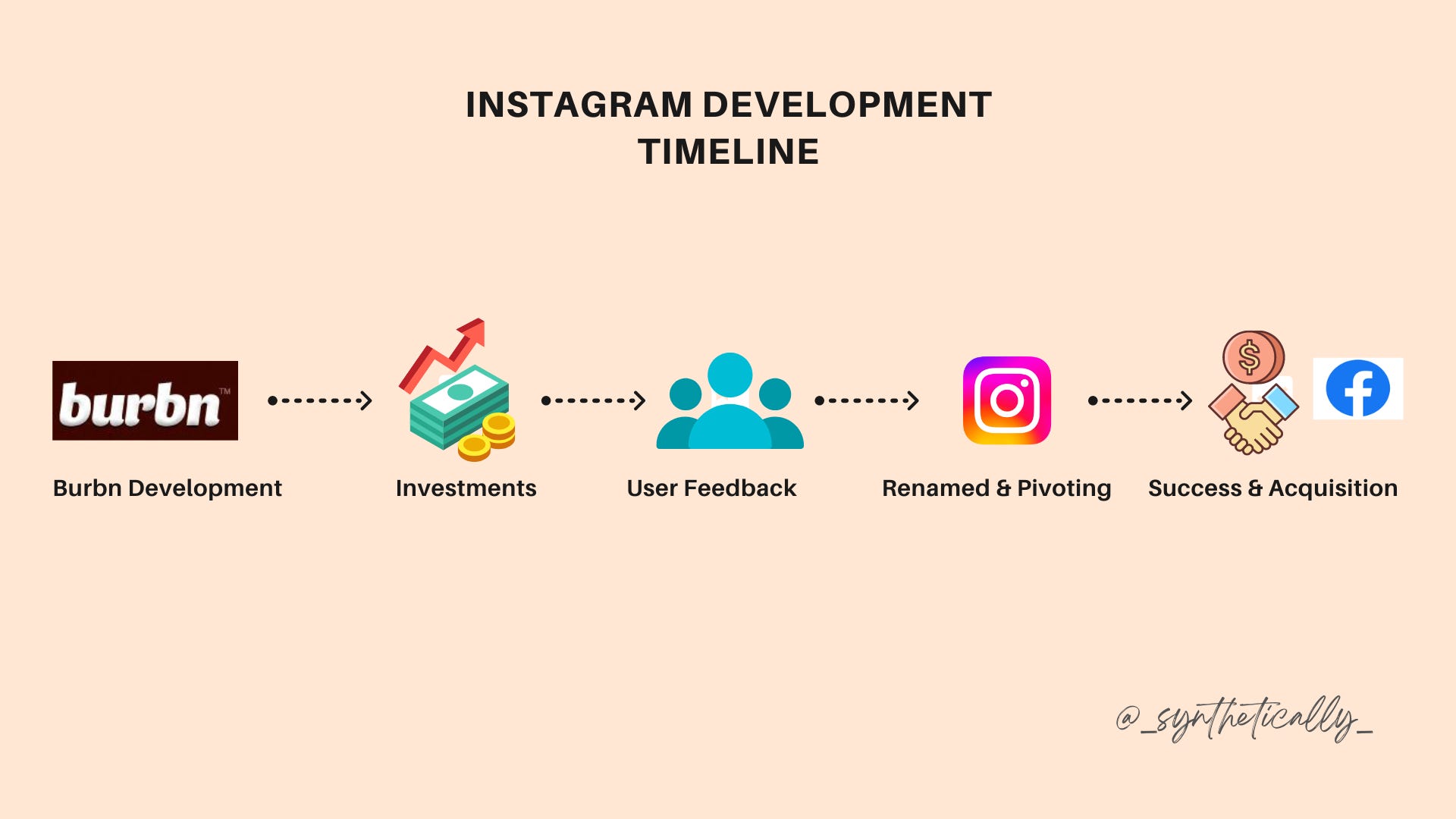
The founders were faced with a decision; to pivot or to persevere and they chose to pivot. Instagram was an instant success that was then acquired by Facebook for $1 billion.
Why we Hate Quitting 🗙
I believe for everything we have been taught, to unlearn it we need to know the reasons we are doing it. Therefore, I have listed below some of the most common reasons why we hate to quit:
We believe that success is the result of sticking to a goal
Sunk cost fallacy - we’ve invested money, energy, time, and resources. We think it will be a waste of all of those if we do not keep going
People are certainty seekers, they want to keep going to see how it turns out, it might work out well
Why it is Okay to Quit 👌
When making a decision, there are 2 things against you; luck and lack of information. Taking control of your life and your decisions is important. Below are some reasons why quitting is okay:
It takes courage to decide that your strategy is failing and quit to commit to your next move
It creates space, for something that will be a better fit with your needs and desires
Saves a lot of time and energy
Speeds us progress
How to Improve on Quitting 🚪
According to Annie Duke, author of the book “Quit: The Power of Knowing When to Walk Away”, there are 2 ways we can improve on quitting:
To create “Kill Criteria” - an effective strategy to quit faster is by removing emotion from the equation. Have advanced planning by imagining which signals in the future would tell us to walk away and write them down. This is something that you can also do after starting to do something.
To find a “Quit Coach” - to find someone who can speak the truth in your decision-making process and can help you quit faster. When you look at it on the outside it can be seen clearly, but on the inside not.
No matter how you decide to call it, pivoting, quitting, or changing your mind or perspective, quitting is not a bad thing. It is a change in direction that will help us a lot to train ourselves to know when to quit.
🪄Quote of the week
“You drown not by falling into a river, but by staying submerged in it.” - Paulo Coelho
Until next time,
Maria