

Learned Helplessness - A Phenomenon You Need to Know
The phenomenon that got me started on this newsletter

Dear community 🧠
Welcome to my first (ever) weekly email. Feels so exciting to write this, I wanted to do this for so long.
This week’s newsletter is about learned helplessness. I found the topic so interesting and inspiring that I wanted it to be the topic of the first newsletter.

What is Learned Helplessness?
Learned helplessness as defined by Psychology Today is when an individual continuously faces a negative, uncontrollable situation and stops trying to change their circumstances, even when they have the ability to do so.
In a study, adults were subjected to noise while completing a task. A group could turn off the noise by pressing a button. Another group had the same noise with the same duration, however, the noise could not be stopped by pressing the button.
The group which could not stop the noise stopped trying to silence the noise.

Learned Helplessness in Everyday Life
I started observing learned helplessness around us everywhere as soon as I learned about it. Some examples are listed below:
Political process 🗳️ - people turning to abstention from voting because they are discouraged by the process feeling that nothing will change
Weight loss 📉 - people trying a few times to lose weight and not getting close to their “goal” resulting in feeling hopeless to try again
Habit change 🏋🏽- people wanting to change a habit like smoking, after several failed attempts they feel helpless and stop trying
Students in class 👩🎓- using ineffective studying strategies and performing badly in exams resulting in them feeling not good or smart enough

Explanatory Styles Role
Some people develop learned helplessness and some do not.
Explanatory styles may play a role in determining how people are impacted by learned helplessness.
Explanatory styles are defined as how people explain the events of their lives to themselves.
Our explanatory style is part of how we process an event, the meaning we give to it and our assessment as a threat or challenge in our lives. It can affect our stress levels in multiple ways. Negative explanatory styles tend to create more stress in life.
There are 2 explanatory styles proposed by psychologists:
Optimistic 📈
Pessimistic 📉
For example, an optimist would attribute the success after getting an “A” in an exam to their work and ability (internal factors) whereas a pessimist would attribute the success to luck or the teacher (external factors). A pessimistic style is one that uses global, stable, and internal explanations for negative events. Whereas, an optimistic style is characterized as using local, unstable, and external explanations for negative events.
Below are the 2 styles with quotes with the above explanations for negative experiences.
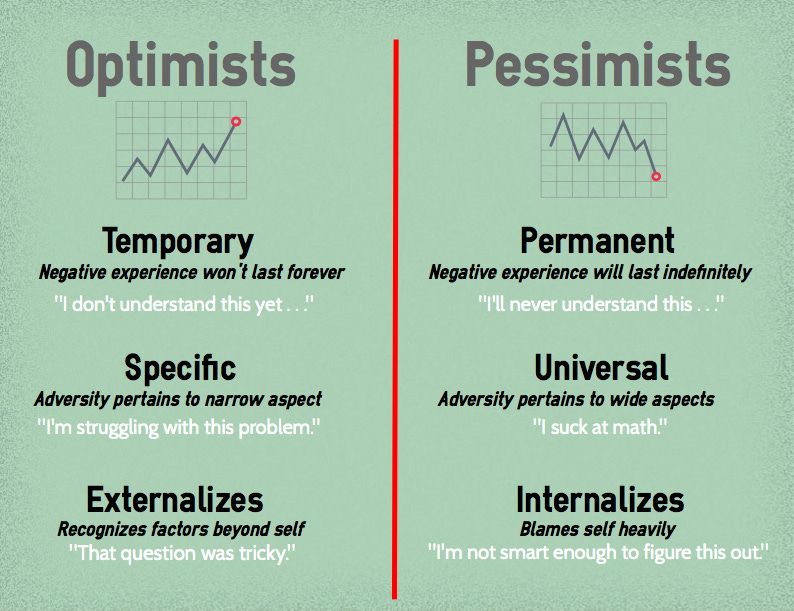
Image Source: https://affectiveliving.com/2016/05/04/the-abcs-of-fostering-optimism/
Overcoming Learned Helplessness
The ABCDE method. Selingman who discovered learned helplessness (along with S. Maier) and defined explanatory styles believed that optimism can be learned (explained below)
Believe that you have control over things more than you think
Do more self-talks
Try new things
Be patient and persistent
Use a journal to write your thoughts
Try therapy
The ABCDE Method
Adversity 🤔 - An unpleasant situation that calls for a response (e.g. Trying to lose weight)
Belief 🧠 - How we interpret the event (e.g. “Nothing works, I can’t do anything”)
Consequence 🤷 - Consequences of our beliefs - the way that we behave or feel (e.g “I feel sad because I am afraid I will fail”)
Disputation ⚖️: - Look for examples that dispute the belief (e.g. “I haven’t tried everything and maybe the goal I set was unrealistic”)
Energy 🔋 - How disputing the beliefs affected your energy (e.g. “I feel more hopeful and positive. I believe my actions will make a difference”)
🪄 Quote of the Week:
“There are two ways of spreading light: to be the candle or the mirror that reflects it.” - Edith Wharton
Until next time,
Maria